

Attahiyat: Full Text, Meaning and Translation
Attahiyat is recited by every Muslim in every prayer, yet many recite it for years without knowing what it means. Also called the Tashahhud, Attahiyat is the beautiful testimony we say while sitting in salah, sending greetings to Allah, peace upon the Prophet Muhammad صَلَّى اللهُ عَلَيْهِ وَعَلَى آلِهِ وَسَلَّمَ and all righteous servants, and bearing witness to the oneness of Allah. In this guide you will find the full Attahiyat in Arabic, its transliteration, English translation and word by word meaning, along with when to recite it and its authentic source.
Attahiyat Full Text in Arabic
التَّحِيَّاتُ لِلَّهِ وَالصَّلَوَاتُ وَالطَّيِّبَاتُ، السَّلَامُ عَلَيْكَ أَيُّهَا النَّبِيُّ وَرَحْمَةُ اللَّهِ وَبَرَكَاتُهُ، السَّلَامُ عَلَيْنَا وَعَلَى عِبَادِ اللَّهِ الصَّالِحِينَ، أَشْهَدُ أَنْ لَا إِلَهَ إِلَّا اللَّهُ، وَأَشْهَدُ أَنَّ مُحَمَّدًا عَبْدُهُ وَرَسُولُهُ
Transliteration:
At tahiyyatu lillahi was salawatu wat tayyibatu. As salamu alayka ayyuhan Nabiyyu wa rahmatullahi wa barakatuh. As salamu alayna wa ala ibadillahis salihin. Ash hadu an la ilaha illallahu, wa ash hadu anna Muhammadan abduhu wa rasuluh.
English translation:
All greetings, prayers and good things are for Allah. Peace be upon you, O Prophet, and the mercy of Allah and His blessings. Peace be upon us and upon the righteous servants of Allah. I bear witness that there is no god but Allah, and I bear witness that Muhammad صَلَّى اللهُ عَلَيْهِ وَعَلَى آلِهِ وَسَلَّمَ is His servant and His Messenger.
Attahiyat Word by Word Meaning
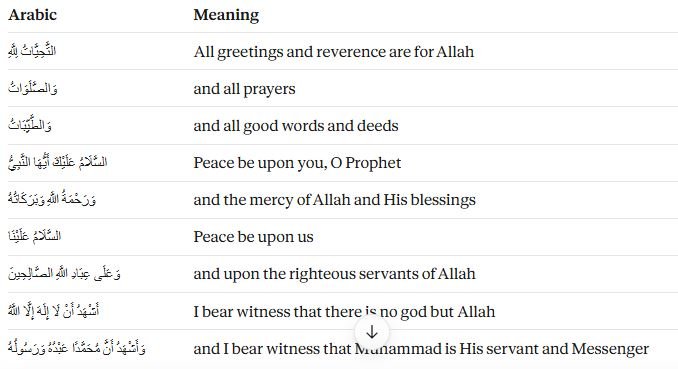
The Authentic Source of Attahiyat
This version of Attahiyat was taught by the Prophet صَلَّى اللهُ عَلَيْهِ وَعَلَى آلِهِ وَسَلَّمَ to Abdullah ibn Mas’ud (may Allah be pleased with him), and is recorded in both Sahih al Bukhari (Hadith 831) and Sahih Muslim (Hadith 402). Ibn Mas’ud said the Prophet taught it to him with his hand between the Prophet’s hands, just as he would teach him a surah of the Quran (Sahih al Bukhari, Hadith 6265).
In the same Hadith, the Prophet explained something beautiful: when you say “peace be upon us and upon the righteous servants of Allah”, your greeting reaches every righteous servant in the heavens and on the earth. So in every prayer, you are sending peace to every righteous soul in all of creation.
Different Versions in the Schools of Fiqh
There are a few authentic versions of the Tashahhud with small differences in wording:
- The version of Ibn Mas’ud (given above) is followed by the Hanafi and Hanbali schools.
- The version of Ibn Abbas, which begins "التَّحِيَّاتُ الْمُبَارَكَاتُ الصَّلَوَاتُ الطَّيِّبَاتُ لِلَّهِ", is recorded in Sahih Muslim (Hadith 403) and preferred by the Shafi’i school.
- The version of Umar ibn al Khattab, recorded in the Muwatta of Imam Malik, is preferred by the Maliki school.
All of these are authentic, and the differences are small. Recite the version you were taught.
When to Recite Attahiyat in Salah
Attahiyat is recited while sitting (qa’dah) in salah:
- In a 2 rakat prayer (such as Fajr), it is recited once, in the final sitting.
- In a 3 or 4 rakat prayer (such as Maghrib, Zuhr, Asr and Isha), it is recited twice: in the first sitting after 2 rakats, and in the final sitting.
In the first sitting, you recite Attahiyat and then stand up for the next rakat. In the final sitting, you recite Attahiyat, then Durood Ibrahim, then a dua, and finally end the prayer with salam.
A Common Misconception
A popular story says that Attahiyat was a conversation between Allah, the Prophet صَلَّى اللهُ عَلَيْهِ وَعَلَى آلِهِ وَسَلَّمَ and the angels on the night of the Mi’raj. This story is widely shared, but it is not found in the authentic Hadith collections. The authentic source of Attahiyat is the teaching of the Prophet to his Companions, as recorded in Sahih al Bukhari and Sahih Muslim. The real beauty of Attahiyat lies in its words, which need no unproven story to be meaningful.
A Final Word
Attahiyat is far more than a formula to recite between rakats. It is a moment of greeting your Lord, sending peace to His Messenger, wishing peace for every righteous soul in creation, and renewing your testimony of faith. The next time you sit in prayer, recite it slowly, understand every word, and feel the weight of what you are saying.


