

How Many Rakats in Each Prayer? Complete Chart
How many rakats are in each prayer? It is one of the first questions every new Muslim, child and returning worshipper asks, and a clear answer makes daily prayer much easier. Each of the five daily prayers has a fixed number of obligatory (fard) rakats, along with sunnah and voluntary (nafl) rakats that the Prophet Muhammad صَلَّى اللهُ عَلَيْهِ وَعَلَى آلِهِ وَسَلَّمَ prayed or encouraged. In this guide you will find a complete chart of the rakats of Fajr, Zuhr, Asr, Maghrib, Isha, Witr and Jumu’ah, followed by a simple explanation of each type of prayer.
Rakats in Each Prayer: Complete Chart
The chart below follows the widely taught Hanafi arrangement, common in Pakistan, India, Bangladesh and Turkey. Differences between the schools are explained after the chart.
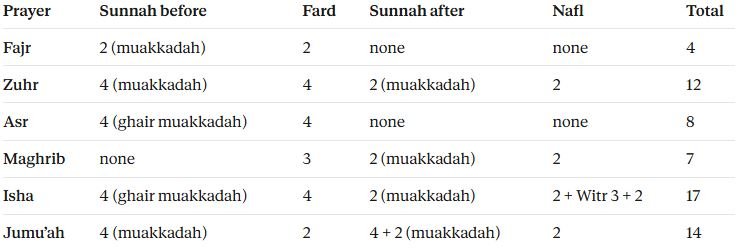
Fard rakats in a day: Fajr 2, Zuhr 4, Asr 4, Maghrib 3, Isha 4, for a total of 17 fard rakats.
Types of Rakats Explained
Fard (obligatory): These rakats must be prayed. Missing them without a valid excuse is a serious sin, and missed fard prayers must be made up later.
Sunnah muakkadah (emphasised sunnah): Prayers the Prophet صَلَّى اللهُ عَلَيْهِ وَعَلَى آلِهِ وَسَلَّمَ prayed regularly and almost never left. A Muslim should not neglect them.
Sunnah ghair muakkadah (non emphasised sunnah): Prayers the Prophet prayed sometimes. They carry great reward, but leaving them is not blameworthy.
Nafl (voluntary): Extra prayers offered for additional reward and closeness to Allah.
Witr: An odd numbered prayer at the end of the night prayer. In the Hanafi school, Witr is wajib (necessary) and is prayed as 3 rakats.
The 12 Daily Sunnah Rakats and Their Reward
The Prophet صَلَّى اللهُ عَلَيْهِ وَعَلَى آلِهِ وَسَلَّمَ said that whoever prays twelve rakats in a day and night, a house will be built for him in Paradise (Sahih Muslim, Hadith 728). In the narration of Jami at Tirmidhi (Hadith 415), these twelve are explained as:
- 2 before Fajr
- 4 before Zuhr and 2 after it
- 2 after Maghrib
- 2 after Isha
These are the sunnah muakkadah prayers shown in the chart. Praying them every day is one of the easiest ways to earn a home in Paradise.
Rakats of Each Prayer in Detail
Fajr: 2 sunnah, then 2 fard. The 2 sunnah of Fajr are the most emphasised of all sunnah prayers. Aishah (may Allah be pleased with her) said the Prophet was never more regular in any voluntary prayer than the two rakats before Fajr.
Zuhr: 4 sunnah, 4 fard, 2 sunnah, 2 nafl. Aishah reported that the Prophet never left the four rakats before Zuhr (Sahih al Bukhari, Hadith 1182).
Asr: 4 sunnah ghair muakkadah, then 4 fard. The Prophet صَلَّى اللهُ عَلَيْهِ وَعَلَى آلِهِ وَسَلَّمَ prayed for Allah’s mercy on whoever prays four rakats before Asr (Sunan Abi Dawud, Hadith 1271; Jami at Tirmidhi, Hadith 430).
Maghrib: 3 fard, 2 sunnah, 2 nafl.
Isha: 4 sunnah ghair muakkadah, 4 fard, 2 sunnah, 2 nafl, 3 Witr, and 2 nafl.
Jumu’ah (Friday prayer): 4 sunnah, 2 fard (prayed in congregation in place of Zuhr), then 4 sunnah and 2 sunnah, and 2 nafl. The Prophet said that whoever prays after Jumu’ah should pray four rakats (Sahih Muslim, Hadith 881).
Differences Between the Schools of Fiqh
All schools agree on the number of fard rakats: 2, 4, 4, 3 and 4. The differences are only in the sunnah and Witr:
- Sunnah before Zuhr: The Hanafis pray 4, based on the Hadith of Aishah. The Shafi’is and Hanbalis consider 2 the confirmed sunnah, based on the Hadith of Ibn Umar (Sahih al Bukhari, Hadith 1180), while also praising 4.
- Witr: The Hanafis hold that Witr is wajib and is 3 rakats with one salam. The other schools consider it a strong sunnah, and allow praying it as 1, 3 or more rakats.
- Jumu’ah sunnah: The number of sunnah rakats after Jumu’ah differs between 2, 4 and 6 among the schools and scholars.
Follow the school you were taught or the guidance of a trusted scholar in your community.
Rakats When Travelling
When travelling a distance that counts as a journey in Islamic law, the 4 rakat fard prayers (Zuhr, Asr and Isha) are shortened to 2 rakats. This is called qasr. Allah says: "وَإِذَا ضَرَبْتُمْ فِي الْأَرْضِ فَلَيْسَ عَلَيْكُمْ جُنَاحٌ أَن تَقْصُرُوا مِنَ الصَّلَاةِ" (Surah An Nisa 4:101), when you travel in the land, there is no blame on you for shortening the prayer. Fajr and Maghrib are not shortened.
A Final Word
Knowing how many rakats are in each prayer is the first step to praying with confidence. Start with the 17 fard rakats, never leave them, then add the 12 sunnah muakkadah rakats to earn a house in Paradise. Keep this chart close, teach it to your children, and let every rakat bring you closer to Allah.


