

Is a Credit Card Halal? Three Scholarly Views, Islamic Alternatives and a Complete Guide
Today, credit cards have become a common need for online shopping, hotel bookings, international travel and global payments. Bank representatives call with offers: “Sir, you have a free credit card offer, with no charges for fifty days.” And many Muslims think: “If I always pay my bill on time and never pay interest, what is the harm?”
That question is the subject of this guide. Scholars hold different views, and each view rests on serious arguments. This guide presents all three views in light of their own fatwas, then offers practical guidance.
How Does a Credit Card Work?
A credit card is essentially a loan facility from a bank:
- Credit limit: the bank sets a limit up to which you can spend.
- Purchase: when you buy with the card, the bank pays the merchant, and you become indebted to the bank.
- Grace period: the bank gives you a period, usually 30 to 50 days, within which no extra amount is charged if you pay the full bill.
- Interest (markup): if you do not pay the full bill within the grace period, or pay only the “minimum payment”, interest starts on the remaining balance.
- Cash advance: withdrawing cash with the card usually has no grace period, and interest starts immediately.
- Merchant fee: on every purchase, the merchant pays the bank a percentage commission; this is not charged to the cardholder.
The legal summary: the relationship between the cardholder and the bank is a loan, and the card agreement includes a clause that interest will be paid on the loan once the grace period ends. The entire disagreement is about this clause.
Debit, Charge and Credit Cards: The Difference
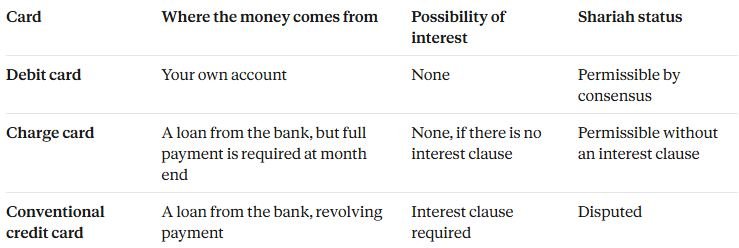
AAOIFI has issued a separate Shariah standard on these three cards, Standard No. 2, and it is included in the compendium of Shariah standards adopted by the State Bank of Pakistan.
Three Scholarly Views
View One: Getting and using a credit card is impermissible in all cases
This is the view of Jamia Uloom ul Islamia Banuri Town and Dar ul Ifta Ahl e Sunnat (Dawat e Islami).
Banuri Town’s fatwa (2024): getting and using a credit card is impermissible and haram, because whether something is permissible depends on the contract agreed between the parties, and the card issuer agrees with the cardholder that if payment is not made within the set period, interest must be paid at a fixed rate under the name of a penalty. The same fatwa cites the legal maxim: “Whatever is forbidden to take is forbidden to give.” banuri
Another fatwa adds that the permissible benefits of a credit card can also be obtained from a debit card, so using a credit card cannot be considered a necessity. banuri
Dar ul Ifta Ahl e Sunnat (Dawat e Islami): according to its fatwa, an interest based agreement is already made when the card is issued, because the cardholder has agreed to pay interest in case of delay; if a delay ever happens and interest has to be paid, that is a second sin, and even if that never happens, getting a credit card is still impermissible. fatwaqa
The core argument of this view: making an interest based agreement is itself a sin, whether
or not interest is ever paid. The Prophet Muhammad صَلَّى اللهُ عَلَيْهِ وَعَلَى آلِهِ وَسَلَّمَ cursed the one who consumes interest, the one who pays it, the one who records it and its witnesses (Sahih Muslim); so even being part of an interest based agreement is a sin.
View Two: Impermissible in principle, but allowed in genuine need with conditions
This is the view of some fatwa institutions, such as Suffah Islamic Research Center and Al Ikhlas.
Suffah Islamic Research Center: according to its fatwa, using a credit card while a debit card is available, or without severe need, is impermissible; but in severe need, for example in non Muslim countries where debit cards are not accepted and buying in cash carries a risk of harm, there is room for it. Its conditions are that the cardholder fully ensures payment before the due date so that there is no chance of interest; does not use the card for anything non compliant; and, since the agreement is based on interest, also repents and seeks forgiveness for that agreement. The same fatwa also clarifies that halal items bought with a credit card do not become haram. کریڈٹ کارڈ استعمال کرنے کا حکم - Suffah Islamic Research Center +2
Al Ikhlas: its fatwa likewise says that using the card is not permissible, unless there is no debit card, charge card or other payment alternative, in which case it may be used on condition that the cardholder pays before the due date and there remains no chance of interest. alikhlasonline
View Three: Permissible on condition of timely payment
This is the view of Jamia Binoria’s fatwa department, Darul Ifta Ashrafia, Minhaj ul Quran and some other scholars.
Jamia Binoria (2016): getting and using a credit card is permissible on condition that the bills are paid within the set period, so that no interest is charged, because paying interest is haram. onlinefatawa
Darul Ifta Ashrafia: where transactions without a credit card cause unusual difficulties, there is room to get and use one, on condition that all bills are paid before the set period, so that no interest has to be paid. darulifta
Minhaj ul Quran: its fatwa describes two cases: if a card is issued under an agreement with no interest clause, using it is clearly permissible; if the agreement includes interest after the grace period, the original agreement is disliked and objectionable because of that clause, but if the cardholder ensures that he will always pay within the period, it may be conditionally permissible as a matter of general need. thefatwa
The core argument of this view: an Indian fatwa institution quotes a Darul Uloom Deoband fatwa saying that if, when signing, one strongly expects to pay the bills within the set period, and signing the interest clause is merely hypothetical, using the credit card is permissible; the condition becomes void in Shariah, while the contract remains valid. Its basis is the hadith: “Whoever stipulates a condition that is not in the Book of Allah, it is void, even if it is a hundred conditions” (Sahih Muslim). In other words, the loan itself is permissible, and the impermissible condition attached to it is automatically void. usmanidarulifta
Comparing the Three Views
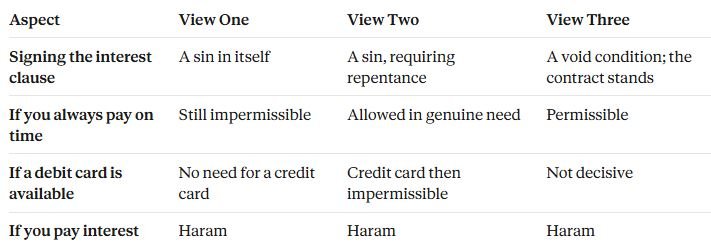
A rational assessment: all three views agree that paying interest is haram. The disagreement is only about how serious it is to sign an interest clause when you do not intend to pay interest. The strength of View One is that the hadith curses even those who take part in an interest agreement, and debit cards have largely removed the need for credit cards. The strength of View Three is that the underlying transaction, a loan, is permissible, and a void condition does not corrupt it. One practical reality is that many people intend to “always pay on time”, but illness, travel or simple forgetfulness eventually causes a delay. That is why View Two represents the most cautious practical path.
Specific Issues
1. Cash advance
Withdrawing cash with a credit card usually incurs immediate interest, which is impermissible according to all views. Jamia Binoria’s fatwa explains that obtaining cash is permissible only if no extra amount is taken on repayment, because any extra amount would be in return for the loan rather than the cost of service, which is pure interest. onlinefatawa
2. Annual fee
If the annual fee is a fixed amount that does not grow with the size of the loan, it can be regarded as a fee for the card service.
3. Reward points and cashback
These are benefits given by the bank to the borrower, the cardholder, not to the lender. So scholars who allow the card generally do not see them as interest. For scholars who forbid the card itself, the question does not arise.
4. The minimum payment trap
Banks offer a “minimum payment” option every month. It looks like a convenience, but interest keeps running on the remaining balance. According to all views, paying only the minimum means falling into interest.
Islamic Credit Cards: The Latest
So far, Islamic banks in Pakistan have mostly offered debit cards, but this is changing:
- Meezan Bank is preparing to launch two Shariah compliant cards, the Meezan Charge Card and the Islamic Financing Card, with commercial rollout expected in 2027; both have already received Shariah approval. propakistani
- The Meezan Charge Card is currently in a soft launch, while the Islamic Financing Card is still under development. propakistani
- According to the bank’s management, the Meezan Charge Card will require full settlement of the balance at month end, without interest charges. mettisglobal
An important caution: scholars also differ on Islamic credit cards. For example, Jamia Banuri Town said about one Islamic bank’s credit card that using it would be impermissible, and the charity imposed for late payment brings the transaction even closer to interest. So consult scholars you trust before taking an Islamic card. banuri
The Prophet’s Guidance on Debt
The biggest danger of a credit card is not only interest, but the habit of debt. The Prophet
Muhammad صَلَّى اللهُ عَلَيْهِ وَعَلَى آلِهِ وَسَلَّمَ used to supplicate in his prayer: “O Allah, I seek refuge in You from sin and from debt.” Someone asked why he sought refuge from debt so often. He replied that when a person is in debt, he speaks and lies, and he promises and breaks his promise (Sahih al Bukhari).
Credit cards make spending so easy that people begin to spend beyond their means. A good principle for a Muslim is to buy only what he already has the money for.
Practical Guidance
If you do not have a credit card
- First choice: use a debit card. Most needs for online shopping and international payments can be met with it.
- If a credit card is truly unavoidable in a genuine need, such as travel abroad, decide according to the scholars you trust.
If you already have a conventional credit card
- The cautious path: close the card and switch to a debit card.
- If you follow the more lenient view, keep these rules:
- Autopay: set up automatic payment of the full statement every month.
- Never make only the minimum payment: always pay the full bill.
- Never take a cash advance.
- A low limit: keep the credit limit below your monthly income.
- Repentance: keep seeking forgiveness for signing the interest clause, as the View Two fatwas advise.
If you are trapped in credit card debt
- Stop new spending: stop using the card immediately.
- Write down everything: your total debt, interest rates and monthly income.
- Pay off the highest rate debt first.
- Cut non essential household spending, and put every extra rupee towards the debt.
- Ask an Islamic bank: some Islamic banks offer halal ways to take over such debt; find out.
- Repentance and dua: repent for past interest and recite often: "اللَّهُمَّ اكْفِنِي بِحَلَالِكَ عَنْ حَرَامِكَ، وَأَغْنِنِي بِفَضْلِكَ عَمَّنْ سِوَاكَ", O Allah, suffice me with what You have made lawful instead of what You have made unlawful, and make me independent of all besides You by Your bounty (Jami at Tirmidhi).
Three Real Life Examples
Faraz, a freelancer: Faraz needed a card to pay for international software. He found out that his Islamic bank’s debit card could be activated for international online payments. He never needed a credit card.
Sadia, trapped in card debt: Sadia kept making only the minimum payment each month, and over two years her debt grew instead of shrinking. She stopped using the card, made a household budget, paid off the full debt within a year, and closed the card.
Dr Usman, travelling abroad: Dr Usman had to book a hotel and car for a conference in Europe, where only credit cards were accepted. He consulted a scholar he trusted, kept a low limit on the card, set up full autopay, and closed the card after the trip.
Shariah Guidance From Our Scholars
If you need Shariah guidance for your specific situation, such as a business need, living abroad, or getting out of credit card debt, you can contact the scholars of Sirat Islamic Academy.
👉 Website: siratislamic.com/contact
👉 Email: siratislamic.com@gmail.com
👉 WhatsApp: +92 322 4159683


