

Sayyidul Istighfar Dua: Meaning and Benefits
Sayyidul Istighfar is the greatest dua for seeking forgiveness in Islam. Its name means “the master of seeking forgiveness”, and it was given this title by the Messenger of Allah, Muhammad صَلَّى اللهُ عَلَيْهِ وَعَلَى آلِهِ وَسَلَّمَ, himself. You may also see it written as Sayedul Istighfar, Sayyid ul Istighfar or Syed ul Istighfar dua; they all refer to the same authentic dua from Sahih al Bukhari. Whoever recites it in the morning or evening with certainty is promised Paradise. In this guide you will find the full Sayyidul Istighfar in Arabic, its transliteration and English translation, its meaning line by line, its benefits, and the best time to read it.
Sayyidul Istighfar Full Dua in Arabic
اللَّهُمَّ أَنْتَ رَبِّي لَا إِلَهَ إِلَّا أَنْتَ، خَلَقْتَنِي وَأَنَا عَبْدُكَ، وَأَنَا عَلَى عَهْدِكَ وَوَعْدِكَ مَا اسْتَطَعْتُ، أَعُوذُ بِكَ مِنْ شَرِّ مَا صَنَعْتُ، أَبُوءُ لَكَ بِنِعْمَتِكَ عَلَيَّ، وَأَبُوءُ لَكَ بِذَنْبِي، فَاغْفِرْ لِي، فَإِنَّهُ لَا يَغْفِرُ الذُّنُوبَ إِلَّا أَنْتَ
Transliteration:
Allahumma anta Rabbi, la ilaha illa anta. Khalaqtani wa ana abduka, wa ana ala ahdika wa wa’dika mastata’tu. A’udhu bika min sharri ma sana’tu. Abu’u laka bi ni’matika alayya, wa abu’u laka bi dhanbi, faghfir li, fa innahu la yaghfirudh dhunuba illa anta.
English translation:
O Allah, You are my Lord. There is no god but You. You created me, and I am Your servant. I am keeping my covenant and my promise to You as much as I am able. I seek refuge in You from the evil of what I have done. I acknowledge Your blessings upon me, and I acknowledge my sins, so forgive me, for none forgives sins except You.
The Hadith of Sayyidul Istighfar
This dua comes from a Hadith narrated by Shaddad ibn Aws (may Allah be pleased with him). The Messenger of Allah صَلَّى اللهُ عَلَيْهِ وَعَلَى آلِهِ وَسَلَّمَ said that the master of seeking forgiveness is to say this dua. He then said:
وَمَنْ قَالَهَا مِنَ النَّهَارِ مُوقِنًا بِهَا فَمَاتَ مِنْ يَوْمِهِ قَبْلَ أَنْ يُمْسِيَ فَهُوَ مِنْ أَهْلِ الْجَنَّةِ، وَمَنْ قَالَهَا مِنَ اللَّيْلِ وَهُوَ مُوقِنٌ بِهَا فَمَاتَ قَبْلَ أَنْ يُصْبِحَ فَهُوَ مِنْ أَهْلِ
الْجَنَّةِ
(Sahih al Bukhari, Book of Supplications, Hadith 6306)
Whoever says it during the day with firm faith in it and dies that day before evening will be among the people of Paradise. And whoever says it at night with firm faith in it and dies before morning will be among the people of
Paradise.
Sayyidul Istighfar Meaning: Line by Line
Why is this dua called the “master” of all duas for forgiveness? Because in a few lines it gathers everything a sincere repentance needs. Let us look at it line by line:
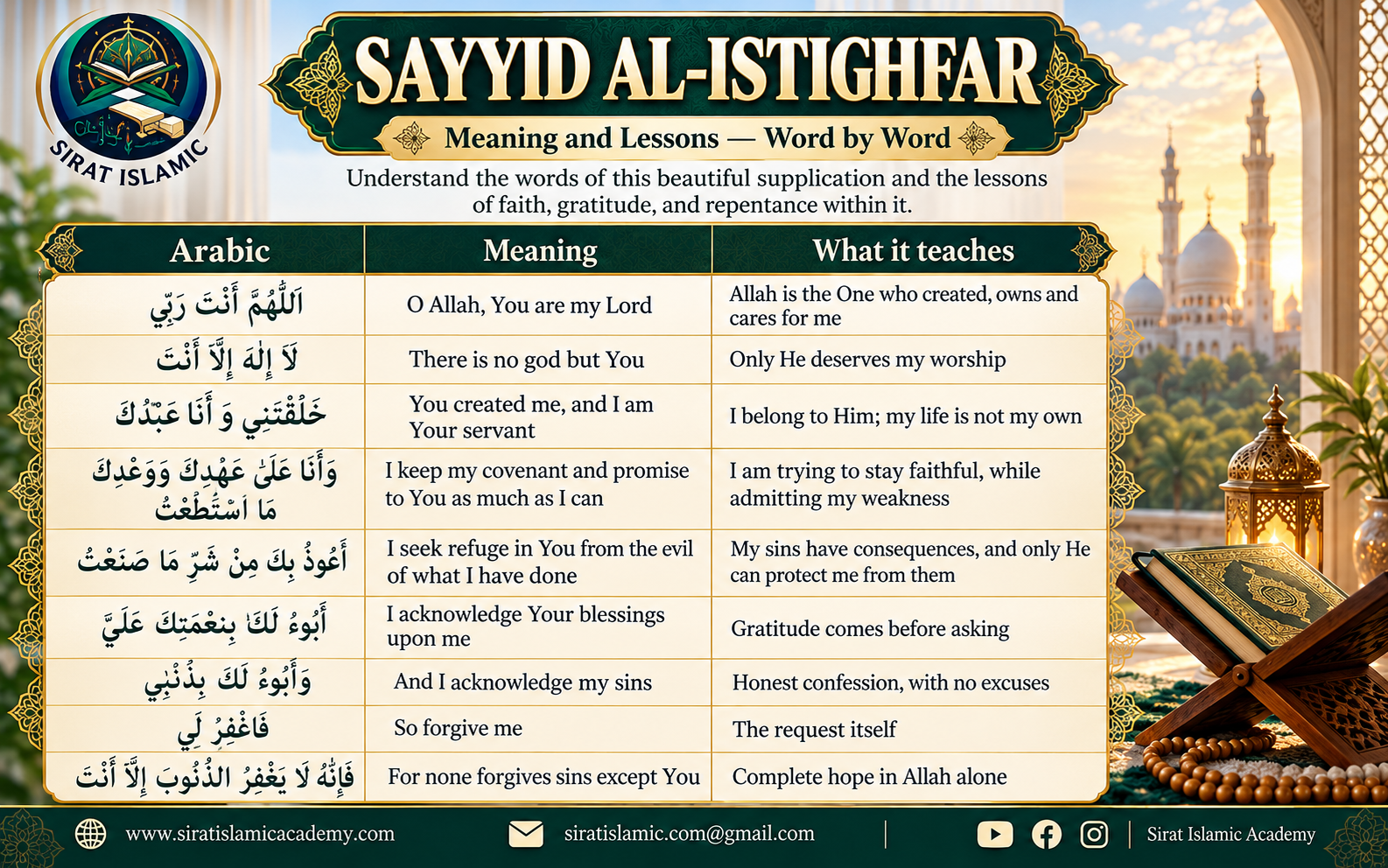
Notice the order. The dua does not begin with “forgive me”. It begins with who Allah is, then who I am, then my promise, then my gratitude, then my confession, and only then my request. This is the language of a servant who understands his place before his Lord. The words “as much as I am able” are especially beautiful: they admit that no human can keep the covenant perfectly, and they rely on Allah’s mercy to cover the gap.
Benefits of Sayyidul Istighfar
1. A promise of Paradise. As the Hadith states, whoever says it with certainty in the day and dies before evening, or at night and dies before morning, is among the people of Paradise. This is one of the clearest promises attached to any daily dua.
2. Forgiveness of sins. As the master of all istighfar, it is the most complete way to ask for forgiveness. The Prophet صَلَّى اللهُ عَلَيْهِ وَعَلَى آلِهِ وَسَلَّمَ, though forgiven, said: by Allah, I seek Allah’s forgiveness and turn to Him in repentance more than seventy times a day (Sahih al Bukhari, Hadith 6307). If he sought forgiveness so often, how much more do we need it?
3. The blessings of istighfar in this world. The Quran links seeking forgiveness with blessings in this life too. Prophet Nuh (peace be upon him) told his people:
فَقُلْتُ اسْتَغْفِرُوا رَبَّكُمْ إِنَّهُ كَانَ غَفَّارًا يُرْسِلِ السَّمَاءَ عَلَيْكُم مِّدْرَارًا وَيُمْدِدْكُم بِأَمْوَالٍ وَبَنِينَ وَيَجْعَل لَّكُمْ جَنَّاتٍ وَيَجْعَل لَّكُمْ أَنْهَارًا (Surah Nuh 71:10 to 12)
I said: Ask your Lord for forgiveness; indeed He is ever Forgiving. He will send rain from the sky upon you in abundance, and give you increase in wealth and children, and provide for you gardens and rivers.
4. A daily reset for the heart. Reciting Sayyidul Istighfar every morning and evening keeps a believer honest with himself. It builds gratitude, humility and hope, and it stops sins from piling up unnoticed.
When to Read Sayyidul Istighfar
According to the Hadith, read Sayyidul Istighfar:
- In the morning, as part of your morning adhkar after Fajr.
- In the evening, as part of your evening adhkar after Asr or at the start of the night.
The Hadith does not set a number of repetitions, so reciting it once in the morning and once in the evening fulfils the Sunnah. You may also recite it at any other time, especially after committing a sin, or in the last part of the night.
Common Mistakes with Sayyidul Istighfar
- Reciting it without certainty. The Hadith says "موقنًا بها", with firm faith in it. The promise is tied to a heart that truly believes what the tongue is saying.
- Treating it as a formula for worldly wishes. Istighfar does bring blessings, as the Quran says, but claims that a set number of recitations guarantees a job, marriage or wealth are not found in authentic sources.
- Rushing through the words. This dua is a confession. Reading it slowly, while understanding each line, is what gives it its power.
- Saying it while insisting on the sin. True istighfar includes regret and a sincere intention to stop the sin, not just words on the tongue.
A Final Word
Sayyidul Istighfar is a gift from the Messenger of Allah صَلَّى اللهُ عَلَيْهِ وَعَلَى آلِهِ وَسَلَّمَ to every believer who has ever felt the weight of his own mistakes. In under a minute, it teaches you to remember who your Lord is, who you are, what He has given you and what you owe Him. Then it lets you ask for forgiveness from the only One who can grant it. Memorise it, teach it to your family, and make it the first and last dua of your day, with certainty in your heart and hope in His mercy.


