
After School Quran Classes for Kids in Europe
Your child comes home from school, has a snack, does homework, maybe has football or swimming, then dinner and bed. Where does the Quran fit in? For many Muslim parents in Europe, this is the hardest part of raising children with a strong connection to the Quran.
In many European countries, schools do not teach the Quran, and the nearest madrasa may be far away or only open at weekends. After school Quran classes online give families a practical answer: short, regular lessons at home, with a qualified teacher, at a time that fits your child’s week.
This guide shows you exactly how to make it work.
Why After School Quran Classes Matter
The Quran is learned through regular practice. A child who reads a little every day progresses much faster than one who reads a lot once a week. Allah says:
وَرَتِّلِ الْقُرْآنَ تَرْتِيلًا (Surah Al Muzzammil 73:4)
And recite the Quran with measured recitation.
Measured, correct recitation needs a teacher who listens and corrects, and it needs routine. After school classes build that routine into ordinary weekdays, so Quran learning becomes as normal as homework or music practice.
Ideal Lesson Length and Frequency by Age
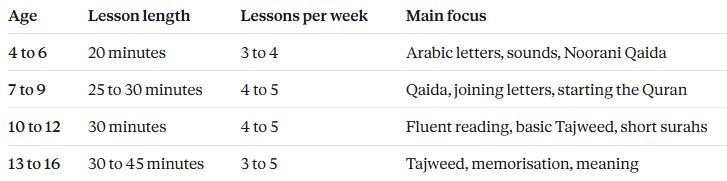
A simple rule: For young children, attention lasts roughly as many minutes as their age, plus a little more. Short and frequent beats long and rare.
The Best After School Time Slots
Most European schools finish between early and mid afternoon. These slots usually work best:
- Straight after school (around 3:30 to 4:30 pm): good for younger children before tiredness sets in.
- After snack and rest (around 4:30 to 5:30 pm): the most popular slot for primary school children.
- After homework (around 6:00 to 7:00 pm): good for older children and teens.
- Weekend mornings (around 10:00 am): perfect for an extra lesson or revision.
Avoid slots right before bedtime for young children. A tired child struggles to concentrate on the letters and sounds.
For a full time zone table for every European country, see our main guide Online Quran Classes in Europe: Timings for Every Time Zone.
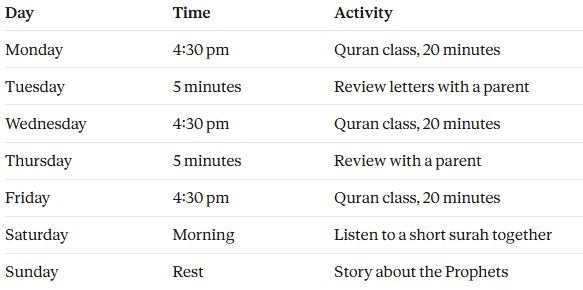
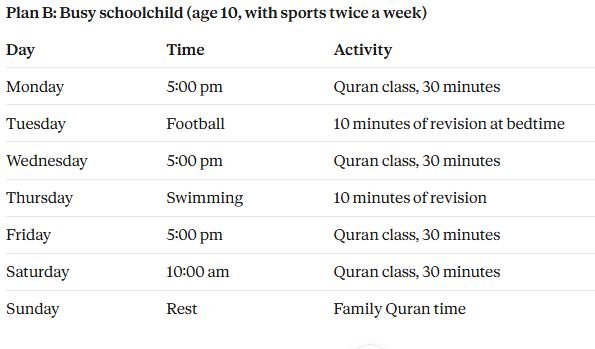
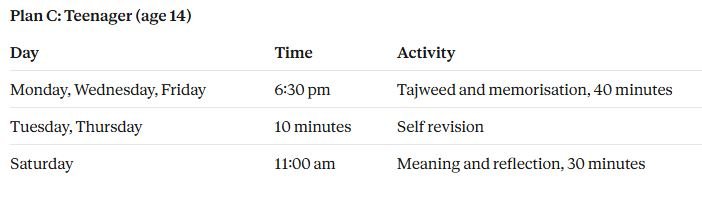
Weekly Plans You Can Copy
Plan A: Young beginner (age 6)
The Learning Path: From Letters to Fluent Recitation
A good after school programme follows clear steps:
- Noorani Qaida: Arabic letters, sounds, short vowels and joining letters.
- Quran reading: reading directly from the Mushaf, slowly and correctly.
- Tajweed: rules of pronunciation, such as noon sakinah, madd and qalqalah.
- Hifz: memorising short surahs, then larger portions.
- Understanding: simple meanings, so children know what they recite.
Each child moves at their own pace. In one to one lessons, the teacher decides when your child is ready for the next step.
How to Keep Your Child Motivated
Children lose interest when lessons feel like a chore. These ideas help:
- Same teacher, same time: A familiar teacher and a fixed routine give children confidence.
- Visual lessons: Colourful slides and pictures make letters and rules easier to remember.
- Small wins: Celebrate finishing a Qaida lesson or memorising a surah.
- Parents as role models: Children copy what they see. When they see you reading the Quran, they want to read too.
- Connect it to life: Recite the surah they learned in salah, before sleep, or on a car journey.
- Never use the Quran as a punishment: It should be a source of love and comfort, not stress.
Keeping Online Lessons Safe
Safety is every parent’s first concern. Follow these simple steps:
- Use a shared space: Hold lessons in the living room, not behind a closed bedroom door.
- Sit in, especially at the start: Parents can join the first lessons and drop in at any time.
- Use the right platform: Choose a trusted video platform and keep the account under a parent’s control.
- Ask about policies: A reliable academy should explain how it protects children and handles personal data, in line with European privacy rules (GDPR).
- Choose a female teacher if you prefer: Many families feel more comfortable with a female teacher for young children and girls.
Tracking Your Child’s Progress
Ask the teacher for a simple monthly update covering:
- Lessons completed in the Qaida or Mushaf.
- Tajweed rules learned.
- Surahs memorised.
- Attendance and areas to improve.
Regular feedback helps you support your child at home and shows whether the lessons are working.
School Holidays and Ramadan
- Summer holidays: A great time for intensive lessons, or a summer Hifz goal such as memorising Juz Amma.
- Ramadan: Many families increase lessons in Ramadan, when children are naturally more connected to the Quran.
- Exam periods: Reduce lesson length rather than stopping completely, so the habit stays alive.
Start After School Quran Classes Today
Sirat Islamic Academy offers one to one online Quran classes for children across Europe, with expert male and female teachers and modern, slide based teaching designed for young learners. We teach students of all ages, from young beginners to teenagers working on Tajweed and Hifz.
Book your 3 day free trial and find an after school time that suits your child.
👉 Contact us now: siratislamic.com/contact
👉 WhatsApp: +92 322 4159683
You may also find these guides helpful: Learning Quran for Kids and Raising Muslim Children in Europe.