

Islamic Psychology Explained: What the Quran Teaches About the Human Self
Modern psychology asks some of the most important questions a human being can ask. Why do I feel this way? Why do I do things I regret? How can I change? What makes a person whole?
The Quran addressed these questions long before psychology became a modern science. It describes the human self in rich detail: its desires and struggles, its capacity for reflection, its need for meaning, and its path to peace. Muslim scholars over the centuries built on this foundation, producing a deep tradition of understanding the inner life.
Today, this tradition is often called Islamic psychology. This guide explains what it is, what the Quran teaches about the human self, and how its insights can help Muslims, and anyone seeking understanding, live with greater wellbeing.
What Is Islamic Psychology?
Islamic psychology is the study of the human mind, emotions and behaviour in light of the Quran, the Sunnah and the scholarly tradition of Islam, while also engaging with the findings of modern psychology.
It rests on three basic beliefs:
- The human being is more than a body and brain. We are also a soul created by Allah, with a spiritual nature and purpose.
- Revelation is a source of knowledge about the self. The One who created the human soul knows it best.
- Reason and evidence matter too. Sound observation and research can help us understand and heal the mind, as long as they are not used to deny the spiritual dimension.
Islamic psychology does not reject modern psychology. It welcomes what is sound in it, while adding what is often missing: the soul, the Creator and the purpose of life.
The Four Parts of the Self in the Quran
The Quran uses four key words to describe the inner human being. Imam al Ghazali, in his famous work Ihya Ulum al Din, explained that these words often overlap in meaning, but each highlights a different aspect of the self.
1. Nafs: the self and its desires
The word nafs can mean the whole self, but it often refers to the part of us that desires, craves and reacts. The Quran describes three stages of the nafs, which we explore below.
2. Qalb: the heart
In the Quran, the qalb (heart) is not only a physical organ. It is the centre of understanding, faith, intention and emotion. The Quran says:
فَإِنَّهَا لَا تَعْمَى الْأَبْصَارُ وَلَٰكِن تَعْمَى الْقُلُوبُ الَّتِي فِي الصُّدُورِ (Surah Al Hajj 22:46)
For indeed, it is not eyes that are blinded, but blinded are the hearts which are within the breasts.
The Prophet Muhammad صَلَّى اللهُ عَلَيْهِ وَعَلَى آلِهِ وَسَلَّمَ said: “Truly, in the body there is a piece of flesh; if it is sound, the whole body is sound, and if it is corrupt, the whole body is corrupt. Truly, it is the heart” (Sahih al Bukhari and Sahih Muslim).
The goal of the believer is a sound heart:
يَوْمَ لَا يَنفَعُ مَالٌ وَلَا بَنُونَ إِلَّا مَنْ أَتَى اللَّهَ بِقَلْبٍ سَلِيمٍ (Surah Ash Shuara 26:88 to 89)
The Day when there will not benefit anyone wealth or children, but only one who comes to Allah with a sound heart.
3. Aql: reason
The aql is the human capacity to think, reflect, understand and choose. The Quran repeatedly calls on people to use it, and Islamic law treats protecting the intellect as one of its core goals. For a full discussion, see our guide Why the Quran Asks You to Think: Aql and Reflection Explained.
4. Ruh: the spirit
The ruh is the spirit that Allah breathed into the human being:
فَإِذَا سَوَّيْتُهُ وَنَفَخْتُ فِيهِ مِن رُّوحِي فَقَعُوا لَهُ سَاجِدِينَ (Surah Al Hijr 15:29)
So when I have proportioned him and breathed into him of My spirit, fall down to him in prostration.
This verse explains the dignity of every human being. It also explains why material things alone can never fully satisfy us: part of us comes from beyond this world.
A simple way to picture the self
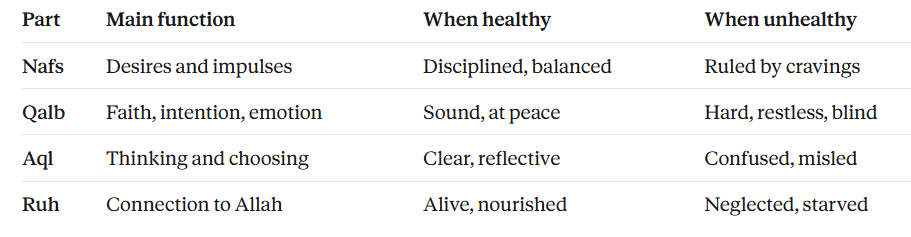
Mental and spiritual wellbeing, in the Islamic view, means bringing these four into harmony.
The Three Stages of the Nafs
One of the Quran’s most powerful psychological insights is that the self is not fixed. It can move through different stages.
1. An nafs al ammarah: the self that commands evil
إِنَّ النَّفْسَ لَأَمَّارَةٌ بِالسُّوءِ إِلَّا مَا رَحِمَ رَبِّي (Surah Yusuf 12:53)
Indeed, the soul is a persistent enjoiner of evil, except those upon which my Lord has mercy.
This is the self ruled by impulses: anger, greed, lust and envy. In modern terms, it is the part of us that acts without reflection. Every human being experiences its pull.
2. An nafs al lawwamah: the self that blames
وَلَا أُقْسِمُ بِالنَّفْسِ اللَّوَّامَةِ (Surah Al Qiyamah 75:2)
And I swear by the self reproaching soul.
This is the self that feels regret after doing wrong. It is the conscience. Its pain is healthy when it leads to change: it is the beginning of growth.
An important psychological point: healthy self reproach is different from harmful self hatred. The lawwamah self says, “I did wrong; I will repent and improve.” Harmful self talk says, “I am worthless; there is no hope.” The first leads to tawbah. The second leads to despair, which Islam forbids: “Do not despair of the mercy of Allah” (Surah Az Zumar 39:53).
3. An nafs al mutmainnah: the self at peace
يَا أَيَّتُهَا النَّفْسُ الْمُطْمَئِنَّةُ ارْجِعِي إِلَىٰ رَبِّكِ رَاضِيَةً مَّرْضِيَّةً (Surah Al Fajr 89:27 to 28)
O reassured soul, return to your Lord, well pleased and pleasing to Him.
This is the self that has found peace with Allah. It is not a self without struggles, but a self that is anchored. This is the ultimate goal of Islamic psychology.

Tazkiyah: The Path of Growth
How does a person move from the impulsive self to the peaceful self? The Quran calls this process tazkiyah, purification and growth of the self:
وَنَفْسٍ وَمَا سَوَّاهَا فَأَلْهَمَهَا فُجُورَهَا وَتَقْوَاهَا قَدْ أَفْلَحَ مَن زَكَّاهَا وَقَدْ خَابَ مَن دَسَّاهَا (Surah Ash Shams 91:7 to 10)
And by the soul and He who proportioned it, and inspired it with its wickedness and its righteousness, he has succeeded who purifies it, and he has failed who corrupts it.
These verses contain a complete psychology in four lines:
- The self is created with balance (“He proportioned it”).
- It has both good and bad tendencies (“its wickedness and its righteousness”).
- We have the power to choose which tendencies to grow.
- Success depends on that choice (“he has succeeded who purifies it”).
The word zakka carries two meanings: to purify, and to make grow. Tazkiyah is not only removing what is bad; it is also nurturing what is good, like a gardener who removes weeds and waters the flowers.
The Practical Tools of Islamic Psychology
Islam does not only describe the self; it gives practical tools for caring for it. Many of these have clear psychological benefits.

These are not “techniques” to be used without faith. Their deepest power comes from their purpose: they connect the self to its Creator. But their psychological benefits are real, and they show how deeply Islam cares for the human mind.
Islamic Psychology and Modern Psychology
How does Islamic psychology relate to modern psychology? The answer is neither total rejection nor blind acceptance.
Where they agree
- Thoughts influence feelings and behaviour.
- The mind and body affect each other.
- Habits can be changed through practice.
- Social connection is vital for wellbeing.
- Mental illness is real and deserves treatment.
What Islamic psychology adds
- The soul: human beings are not only biological machines.
- Purpose: life has a meaning given by the Creator.
- Accountability and hope: our choices matter, and repentance is always possible.
- A relationship with Allah: the deepest source of peace.
- Moral guidance: not every desire should be fulfilled.
A rich history
Muslim scholars have written about the inner life for over a thousand years. The ninth century scholar Abu Zayd al Balkhi classified emotional disorders and described methods remarkably close to modern cognitive therapy. Read more in our article Al Balkhi: The 9th Century Muslim Scholar Who Wrote on Mental Health.
Later scholars such as Imam al Ghazali and Ibn al Qayyim wrote deeply about the heart, desires, emotions and the path to inner peace. In modern times, the Sudanese psychologist Dr Malik Badri helped revive interest in this field, including through his influential book The Dilemma of Muslim Psychologists.
Important Cautions
Islamic psychology is powerful, but it must be practised wisely.
1. It does not replace medical care
Islamic practices support mental health, but they do not replace professional treatment for conditions such as depression, anxiety disorders or OCD. The Prophet صَلَّى اللهُ عَلَيْهِ وَعَلَى آلِهِ وَسَلَّمَ commanded seeking treatment for illness. Faith and therapy work best together.
2. Avoid “spiritual bypassing”
Spiritual bypassing means using religious language to avoid dealing with real pain: telling a grieving person to “just be patient” without allowing them to grieve, or telling someone with depression to “just pray more”. Islam does not teach this. The Prophets felt and expressed deep emotion, and the Sunnah teaches us to acknowledge pain, not deny it.
3. Beware of unqualified “healers”
Some people claim to offer “Islamic therapy” without proper training, or blame every problem on spiritual causes. Real Islamic psychology respects both sound religious knowledge and sound clinical knowledge.
Explore the Series: Quran, Psychology and the Human Self
This page is the starting point for our series on Islamic psychology. Each article below explores one topic in depth:
Emotions and Mental Health
- What the Quran Says About Anxiety and Overthinking: the Quranic difference between fear and grief, and a seven step method.
- Is Depression a Lack of Faith? What Islam Really Says: why sorrow is not weak faith, and a balanced path to recovery.
- Religious OCD (Waswasa): A Practical Guide for Muslims: the Islamic rule that certainty is not removed by doubt.
Meaning, Reason and Faith
- The Meaning of Life According to the Quran: the Quran’s six layered answer to “Why am I here?”
- Why the Quran Asks You to Think: reason, questions and doubts in Islam.
Islam and Modern Trends
- Stoicism vs the Quran: what ancient philosophy got right, and what it missed.
- Manifestation vs Dua: does the Law of Attraction fit Islam?
History of Islamic Psychology
In Urdu and Roman Urdu
Questions? Speak to Our Scholars
If you have questions about the Islamic perspective on the self, emotions or mental wellbeing, you can contact the scholars of Sirat Islamic Academy for guidance. For diagnosis and treatment of mental health conditions, please always consult a qualified professional.
👉 Website: siratislamic.com/contact
👉 WhatsApp: +92 322 4159683
Begin With the Quran
The Quran describes itself as “a healing for what is in the breasts” (Surah Yunus 10:57). The deepest form of Islamic psychology begins with understanding the words of the One who created the human soul.
At Sirat Islamic Academy, you can learn:
- Quran Translation: understand the Quran’s guidance for the heart and mind.
- Quran Reading and Noorani Qaida: begin from the very first letters.
- Tajweed: recite correctly and beautifully.
- Hifz ul Quran: carry the Quran in your heart.
We offer one to one online classes for all ages, with expert male and female teachers, and modern, slide based teaching for children. Book your 3 day free trial. Contact us now.


