

What Is Murabaha? A Complete Guide to Murabaha Financing
If you take financing from an Islamic bank for raw materials, stock or machinery, it is very likely to be based on “murabaha”. It is the most popular method in Islamic banks, and so it also raises the most questions: “The bank still takes more money in murabaha, so why is it not interest?” “A bank is not a shop, so how does it sell goods?” “All the papers were signed on one day, so when did the sale happen?”
This guide answers these questions in full. It covers every aspect of murabaha, from its basis in Islamic law to the bank’s documents, common mistakes and the customer’s responsibility.
What Is Murabaha?
The word “murabaha” comes from the Arabic “ribh”, meaning profit. In Islamic law, murabaha is a sale in which the seller clearly tells the buyer how much the item cost him and how much profit he is adding. In English it is called a cost plus sale.
Murabaha belongs to the “sales of trust” (buyu al amanah), in which the buyer relies on the cost stated by the seller. So honesty is a basic condition: if the seller misstates his cost, the buyer may cancel the deal or have the price reduced by the amount of the misstatement.
The Shariah Basis of Murabaha
Murabaha is not a modern invention; it has been recognised for centuries in books of Islamic law as a valid sale. Its basis is the Quranic declaration: "وَأَحَلَّ اللَّهُ الْبَيْعَ وَحَرَّمَ الرِّبَا", Allah has made trade lawful and interest unlawful (Surah Al Baqarah 2:275). Since murabaha is a form of sale, its permissibility follows from the permissibility of sale. The four Imams accept it, as long as the cost and profit are known.
An important clarification: In origin, murabaha is not a financing method, but a trade transaction. Islamic banks combine it with “bai muajjal”, a deferred payment sale, to meet financing needs.
Murabaha in Banks: Murabaha to the Purchase Orderer
A bank is not a shop with goods on its shelves. So banks use a special form of murabaha, known in Islamic law as “murabaha to the purchase orderer”: the customer asks the bank to buy an item and promises that, once the bank buys it, he will buy it from the bank.
The International Islamic Fiqh Academy has also accepted this form, provided the bank genuinely owns the item and bears its risk. AAOIFI issued Shariah Standard No. 8 on it, which the State Bank of Pakistan adopted in its very first phase. In its circular of 12 January 2010, the State Bank of Pakistan adopted AAOIFI Standard No. 8 (Murabaha to the Purchase Orderer) among the standards in its first phase.
(Circular: https://www.sbp.org.pk/ibd/2010/C1.htm) sbp
The Seven Steps of Murabaha in an Islamic Bank
Suppose a textile factory needs yarn worth 1,000,000 rupees but has no cash. In an Islamic bank, the deal goes through these seven steps:
Step 1: Master Murabaha Facility Agreement:
The bank and the factory sign a framework agreement setting out general terms: the financing limit, how profit is set, the payment method and securities. This is not yet a sale; it is only a framework for future deals.
Step 2: Promise to Purchase:
The factory promises that if the bank buys the yarn, it will buy it from the bank. This protects the bank from buying goods only for the customer to refuse them. If the customer breaks the promise, he compensates the bank only for its actual loss from selling the goods more cheaply; claiming expected profit is not allowed.
Step 3: Agency Agreement:
Often the bank appoints the factory as its agent to buy the yarn from the supplier on the bank’s behalf, using the bank’s money. At this stage, the factory is not a buyer but the bank’s representative.
Step 4: The Bank’s Purchase:
The factory, as the bank’s agent, buys the yarn from the supplier. The bank pays, preferably directly to the supplier. The yarn now belongs to the bank.
Step 5: Possession and Risk:
The yarn may physically be with the factory, but it holds it in trust for the bank. This is the bank’s constructive possession. If the yarn is destroyed by fire or disaster during this time, the loss is the bank’s. This is the step that separates murabaha from interest, because the bank owns a real asset and bears its risk.
Step 6: Offer and Acceptance:
After the purchase, the factory, now acting as buyer rather than agent, informs the bank that the goods have been bought and offers to purchase them. The bank accepts. The actual sale happens now: the bank sells yarn worth 1,000,000 rupees to the factory for 1,100,000 rupees, for example on six months’ credit.
Step 7: Payment and Security:
The factory pays 1,100,000 rupees on the agreed date or in instalments. To secure payment, the bank may take a rahn (pledge), a personal guarantee or a promissory note.
Essential Conditions of Murabaha
1. The item must exist and be owned by the bank:
The Prophet Muhammad صَلَّى اللهُ عَلَيْهِ وَعَلَى آلِهِ وَسَلَّمَ told Hakim ibn Hizam: "لَا تَبِعْ مَا لَيْسَ عِنْدَكَ", do not sell what you do not have (Sunan Abi Dawud, Hadith 3503).
2. The bank must bear the risk:
Between purchase and sale, the risk of the goods must be on the bank. The Prophet صَلَّى اللهُ عَلَيْهِ وَعَلَى آلِهِ وَسَلَّمَ forbade profit on something whose risk one has not borne (Jami at Tirmidhi, Hadith 1234).
3. The price must be fixed once and finally:
At the time of sale, the price and payment period must be fixed, and must never increase afterwards.
4. The cost must be disclosed:
The bank must clearly state its actual cost; purchase invoices and documents are the proof.
5. Murabaha must involve a real item:
Murabaha cannot be used for cash, salaries, bills or repaying old debts, because there is nothing to buy.
6. The item must be halal:
Alcohol, interest based assets or anything forbidden cannot be the subject of murabaha.
7. The supplier must be separate from the customer:
If the customer sells his own goods to the bank and buys them back, it becomes bai al inah.
How Is the Price Set? The Benchmark Rate Issue
Many Islamic banks use a benchmark such as KIBOR (Karachi Interbank Offered Rate), the rate at which banks in Pakistan lend to each other, as a reference for setting murabaha profit. Similar benchmarks are used elsewhere in the world. This raises the question: if the profit is set using an interest rate, why is it not interest?
The answer: Mufti Muhammad Taqi Usmani has answered this objection with an example in his writings: if a Muslim trader who does not sell alcohol sets the profit on his halal goods by looking at how much alcohol sellers earn, his trade does not become haram. A transaction’s permissibility depends on its nature, not on the reference used to set its price. In murabaha, the bank owns and sells a real asset; whatever benchmark sets the profit, the transaction remains a sale.
However, he accepts that this is not ideal. It would be better for Islamic banking to have its own benchmark based on real economic returns. This objection is examined in detail in Part Four of this series.
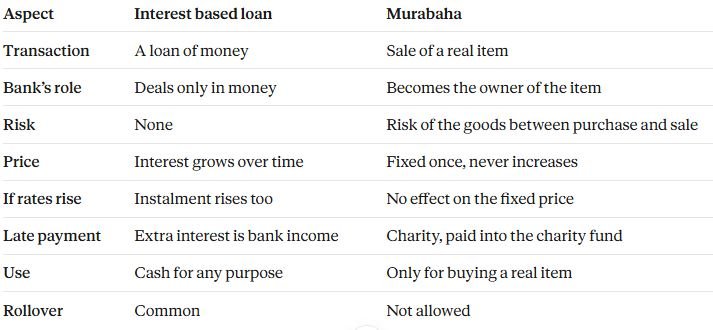
A key difference: in an interest based loan, if the rate rises, your instalment rises too. In murabaha, once the price is fixed, no matter how much the benchmark rises, your amount does not increase by a single rupee.
When Does Murabaha Become Interest? Seven Common Mistakes
The structure of murabaha is permissible, but if its conditions are not met, it effectively becomes interest:
1. Signing all documents at once:
If the sale agreement is signed before the purchase, the bank is selling something it does not own.
2. Backdated invoices:
If the customer has already bought the goods for himself, and is later shown on paper as the bank’s agent, the bank has bought nothing; it is mere paperwork.
3. Bai al inah:
The customer sells his own goods to the bank and then buys the same goods back on credit at a higher price.
4. Rollover:
On the due date, a new murabaha is done on the same goods to extend the term and increase the price. This resembles the pre Islamic interest of “pay now, or increase the amount”.
5. Cash murabaha:
Giving cash under the name of “murabaha” to pay salaries or bills.
6. Payment into the customer’s account:
If the bank puts the purchase money into the customer’s account instead of paying the supplier, and the customer uses it for anything, it is effectively a cash loan.
7. Increasing the price for late payment:
The bank taking extra money for itself because of a late instalment.
This is why the Shariah compliance department of an Islamic bank checks the purchase invoices, the sequence of dates and proof of ownership in every murabaha transaction.
Late and Early Payment
Late payment:
The bank may not take any extra money for itself. To ensure timely payment, the customer undertakes to give a sum to charity if he pays late; this money goes into the bank’s charity fund, does not become the bank’s income, and is spent on welfare under the Shariah board’s supervision. AAOIFI Standard No. 3 (Default in Payment by a Debtor) covers this.
Early payment:
According to Mufti Muhammad Taqi Usmani, it is not correct to stipulate in the contract that the price will be reduced for early payment, because that makes the price uncertain; however, the bank may voluntarily give a rebate, without any prior condition.
Murabaha vs an Interest Based Loan
Why a Higher Credit Price Is Not Interest
This is the most common question. The answer is that in Islamic law, a deferred sale may be priced higher than a cash sale, and the majority of scholars agree on this, as long as the price is fixed once at the time of sale.
Think of it like this:
- In an interest based loan, the “price of time” is charged on money, and the amount keeps growing with every day of delay.
- In a deferred sale, the price of an item is set, taking the credit period into account. Once the sale is complete, that price becomes a fixed amount, which does not grow by a single rupee with delay.
Money and goods are two different realities: the price of goods can depend on market demand, quality and payment time, while money can only be exchanged for money in equal amounts.
Mufti Taqi Usmani’s View: Permission With Caution
Mufti Muhammad Taqi Usmani, who played a central role in founding Islamic banking in Pakistan, takes a balanced position on murabaha in his book “An Introduction to Islamic Finance”:
- Murabaha is not an ideal financing method, but a transitional one.
- It should be used only where musharakah and mudarabah are not practical.
- All its conditions must be fully observed; otherwise, it becomes nothing more than a change of name.
His warning shows that even the strongest supporters of Islamic banking do not accept murabaha blindly, but clearly state its limits.
Customer Checklist: Is Your Murabaha Correct?
If you are taking murabaha financing, ask these questions:
- Did the bank, itself or through an agent, buy the goods first and then sell them to me?
- Was the purchase money paid to the supplier, or into my account?
- Were the agency and sale documents signed at different times?
- Was the price finally fixed at the time of sale?
- Does any extra amount for late payment go to charity?
- Is the financing being rolled over at the end of the term?
If the answers are satisfactory, your transaction is close to Shariah principles.
Authentic Sources
- State Bank of Pakistan, Essentials of Islamic Modes of Financing: https://www.sbp.org.pk/press/Essentials/Essentials%20of%20Islamic.htm
- State Bank of Pakistan circular adopting AAOIFI standards (2010): https://www.sbp.org.pk/ibd/2010/C1.htm
- State Bank of Pakistan Compendium of Shariah Standards: https://www.sbp.org.pk/ifpd/compendium/Compendium.pdf
A Final Word
Murabaha is neither interest nor permissible in every case; everything depends on following its conditions. When the bank truly owns the item, bears its risk, and fixes the price once without ever increasing it, murabaha is a form of the “trade” that the Quran makes lawful. When those conditions are reduced to paperwork, the same murabaha becomes a disguise for interest. An informed customer should know these conditions and ask the bank to follow them.


