

Is JazzCash and Easypaisa Profit Halal or Haram?
Millions of people in Pakistan use JazzCash and Easypaisa every day to pay bills, send money, top up their phones and shop online. These apps also offer plenty of perks: daily profit for keeping money in your wallet, free minutes and SMS, cashback, and lucky draws with big prizes. Naturally, many Muslims ask: is all of this halal?
There is no single yes or no answer, because each offer works differently. To understand the ruling, we first need to know what your wallet balance actually is in Islamic law.
First, What Is Your Wallet Balance?
JazzCash and Easypaisa are not just apps. Behind each one is a licensed bank. JazzCash operates under Mobilink Microfinance Bank, and Easypaisa is now Pakistan’s first digital retail bank. propakistani
When you deposit money into your wallet, in Islamic terms that money is a loan (qard) to the bank. The bank uses it in its business, and you have the right to take it back whenever you want. This is exactly the same status as a current account in an ordinary bank.
This leads to a basic principle that scholars have stated as: "كُلُّ قَرْضٍ جَرَّ نَفْعًا فَهُوَ رِبًا", every loan that brings a stipulated benefit to the lender is riba (interest). Although its chain as a saying of the Prophet is weak, its meaning is supported by reports from the Companions, and scholars of the Ummah have accepted it unanimously.
Let us now look at each offer in light of this principle.
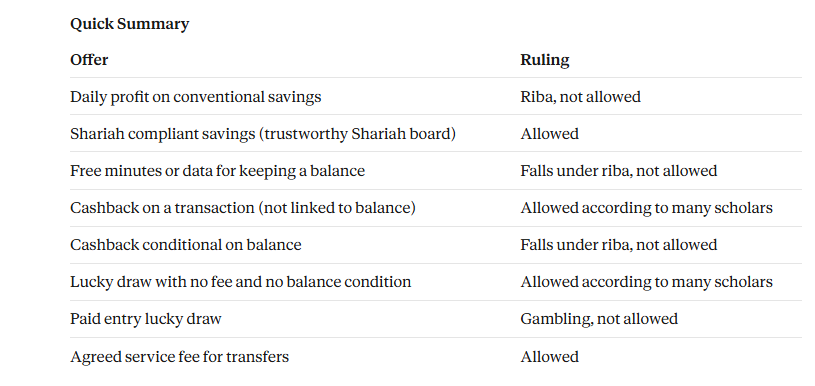
1. Daily Profit on Your Balance
Both Easypaisa and JazzCash offer savings features that pay daily profit on your balance. For example, Easypaisa introduced a feature where users can earn a percentage on their existing account balance every day through an in app savings product; their funds are not locked, and they simply need to keep a balance above their chosen plan’s threshold. digitalpakistan
Ruling: If this savings feature is conventional (interest based), the profit is riba, because:
- Your money is a loan to the bank.
- You receive a fixed rate of increase on it.
- Your principal is guaranteed, and you share in no business loss.
This is exactly the same as a conventional bank savings account. Calling it “profit” does not change the ruling; the ruling depends on what the transaction really is.
2. Shariah Compliant Savings: A Halal Alternative
The good news is that both companies now offer Shariah compliant options:
- JazzCash: With JazzCash’s Shariah compliant savings, customers can save and earn halal profits through daily disbursements, and can withdraw their savings anytime with no money locking. Mobilink Bank has also launched Islamic banking operations, which will allow JazzCash to offer Islamic products. propakistanibrecorder
- Easypaisa: Easypaisa Digital Bank and EFU Life have introduced a digital Islamic Takaful Savings Solution offering halal returns and integrated financial protection through the easypaisa app. digitalpakistan
Ruling: If a savings product is genuinely based on Islamic contracts such as mudarabah, wakalah or takaful, and is supervised by a trustworthy Shariah board, its profit is halal. It is not an increase on a loan, but a share in real business profit.
A word of caution: A label saying “Islamic” or “halal” is not enough on its own. Before choosing a product, check which scholars sit on its Shariah board, and how profit and loss are shared in its terms.
3. Free Minutes, SMS or Data for Keeping a Balance
Sometimes you get free minutes, SMS or an internet package for keeping a certain amount in your wallet.
Ruling: If the reward is given on the condition of keeping money in the wallet, it is a stipulated benefit on a loan, and falls under riba, even though it comes as minutes rather than cash. Riba is not only extra cash; any stipulated benefit gained because of a loan is included.
4. Cashback and Discounts
JazzCash and Easypaisa often give cashback for paying bills, topping up or paying at a shop. There are two situations:
A. Cashback on a transaction, not linked to your balance:
If cashback is given for a specific purchase or payment, and has nothing to do with keeping money in your wallet, many contemporary scholars consider it permissible. In reality, it is a discount or promotional gift, like a shopkeeper saying “ten percent off today”. If the discount comes from the shop or the company issuing the bill, its permissibility is even clearer.
B. Cashback conditional on your balance:
If cashback is only given on the condition that you keep a set amount in your account, it is again a stipulated benefit on a loan, and falls under riba.
A subtle point: Since the company giving the cashback is the same bank that holds your money as a loan, some cautious scholars advise avoiding all cashback. Generally, however, the deciding question is: is this benefit because of keeping money, or because of a transaction?
5. Lucky Draws and Prize Schemes
Sometimes companies hold lucky draws with prizes like cars, phones or cash.
- If entry requires keeping money in your wallet: it is a stipulated benefit on a loan, which falls under riba, and the element of chance also brings it close to gambling.
- If simply using the app or making a transaction is enough to enter, with no extra payment: many scholars consider it a permissible promotional gift from the company.
- If you must pay a separate fee to enter, and only a few people win: this is gambling (maysir), since everyone’s fees fund large prizes for a few. Allah calls gambling the work of Satan (Surah Al Maidah 5:90).
6. Service Fees
JazzCash and Easypaisa charge fees for sending money, withdrawing cash or paying bills. Retailers also often charge a little extra.
Ruling: A fixed and agreed fee for a service is permissible, because it is a wage for a service (ujrah), not interest. However, if a money transfer turns into a loan, for example a shopkeeper lending someone money and taking back more, that is riba.
What If Interest Has Already Been Credited?
Many people have unknowingly received interest in their wallets. Here is what to do:
- For the future: Turn off the conventional savings feature, or switch to the Islamic savings option.
- Interest already received: Without using it yourself, give it to a poor person without the intention of earning reward.
- Do not count it as zakat: Interest cannot become zakat. Pay your zakat separately from your halal wealth. For details, see our article “Zakat on Haram Money”.
A Final Word
JazzCash and Easypaisa are part of modern life, and using them to send money, pay bills and shop is completely permissible. The issue is not with these services, but with the “profits” and “rewards” given simply for keeping money in them. Remember one simple rule: a benefit you get only for keeping money is doubtful or forbidden; a benefit you get for a transaction or service is generally allowed. And if you want to earn on your savings, choose the Shariah compliant options now available in these same apps.


